This FAQ explains what a WFA is, the different stages of the process, and what your options are depending on your situation.
If you have additional questions, consult the Directive or submit an intake form. A labour relations officer will get back to our affected members within two business days.
If an employee refuses a GRJO, they will be laid off. The lay-off will not be sooner than 6 months from the beginning of the surplus period (which began after the 120-day opting period). The employee will continue to be paid and have access to benefits until they are laid off.
If the Employee refuses a GRJO, they will not have access to the lump-sum amount, pension waiver, or to retraining, salary protection or reinstatement priority entitlements.
The WFAD defines Guarantee of a reasonable job offer (GRJO) for lack of work, the discontinuance of a function, and relocation where the employee chooses not to move situations), as an offer of indeterminate employment within the core public administration, normally at an equivalent level. Surplus employees must be both trainable and mobile. Where practicable, a reasonable job offer shall be within the employee's headquarters as defined in the Travel Directive.
The VDP process happens after notifications of affected status are delivered to employees, and before any potential SERLO process. Employees must have a minimum of 30 calendar days to decide whether they want to participate in the VDP process.
Participation in the VDP process is not mandatory. If an employee decides to participate in the VDP process, they must select Options B, C(i) or C(ii).
Options B (TSM) and C(i) - Education Allowance
If an employee decides to participate in the VDP and opts for Option B or C(i), they are considered laid-off for severance pay purposes and work with management to establish a departure date.
The TSM (the lump sum payment) is paid upon resignation. This payment will range from 4 to 52 week’s salary and will vary between employees because it depends on the employee’s years of service. Employees with 16-29 years of service will get the maximum amount.
If an employee selects Option C(ii), they are requesting a LWOP for two years. If they provide proof of registration to a learning institution within 12 months of starting LWOP, their departure date is delayed for a maximum of two years. If they do not provide proof of registration within 12 months of starting LWOP, they are considered laid-off for severance pay purposes at that time.
Under Option C(ii), the lump sum will be equivalent to the TSM plus reimbursement of up to $17,000 for certain educational expenses.
Annex C of the WFAD outlines the years of service calculations for the amount of the TSM. The severance pay is calculated according to section 22.01 of the LP Collective Agreement.
Alternation allows an opting employee who was not offered a GRJO to exchange positions with an unaffected employee who wishes to leave the core public administration a. The Alternation must occur within the 120-day opting period or 12-month surplus period under Option A. The date of Alternation must be specified, and employees must exchange positions on that same day.
Alternation normally occurs between members at the same group and level or occasionally when the two positions are considered equivalent (See the equivalency table). This means the maximum rate of pay for the higher paid position is no more than 6 percent higher than the maximum rate of pay for the lower paid position.
If an unaffected employee alternates, they can only select Option B or C(i). If alternation is during Surplus A period, the alternate’s TSM will be reduced by 1 week for each completed week between beginning of employee surplus period and date of alternation.
Please note that only opting and surplus employees who have chosen Option A are eligible to alternate with a non-affected employee. Management approval is required (but not automatic) for an alternation to occur.
The WFAD states that if an alternation is denied, an employee can request a meeting to discuss the rationale for the decision with the employer, and the bargaining agent representative may be present. If a member feels that the refusal may not be for valid reasons, they are encouraged to submit an intake form with the AJC.
AJC members can access the alternation list by logging in securely to the AJC's website and downloading the list in PDF format to identify a potential match to pursue alternation.
Opting and non-affected members interested in alternation should register on all employer platforms, including the new Treasury Board of Canada Secretariat’s Alternation Portal
Once an employee is opting, they are entitled to $1,200 for financial and job placement counselling services. They also need to pick one of the following three options:
Option A: 12 Month Surplus Period
An Opting employee who chooses Option A will have surplus priority rights for appointment to other positions in the Core Public Administration for 12 months; effectively allowing them to be considered ahead of unaffected employees for open positions.
During this period, they have 12 months to find a reasonable job offer or else they will be laid-off. They can also participate in alternation during this period. Employees selecting Option A (12-month surplus priority) will also continue to work and earn pensionable time.
Option B: Transition Support Measure (TSM)
When choosing this option, the employee resigns and in exchange receives a taxable cash lump-sum payment based on years of service in the Public Service.
While the Employee must resign under this option, they will be considered laid off for purposes of severance pay, which is sperate from the TSM. Under this option, an employee may benefit from a pension reduction waive if they are between the ages of 55-59 years old, have at least 10 years of service and became a Public Service Superannuation Plan member before January 1, 2013, or are between the ages of 60-64 years old, have at least 10 years of service and became a Public Service Superannuation Plan member on or after January 1, 2013.
Information on exact TSM payments in weeks’ pay by year of service can be found in the WFAD (Appendix C).
Option C: Educational Allowance (+ TSM)
When choosing this option, the employee receives the TSM cash payment plus reimbursement of up to $17,000 as an Educational Allowance for receipted expenses for tuition fees, costs of books and relevant equipment.
The Employee has the opportunity to go on leave without pay (LWOP) for a maximum of two years rather than resign and receive severance, where they can continue to contribute to the pension plans and participate in benefits plans (they must pay the employee and employer portions).
However, you are not eligible for a pension reduction waiver under Option C
An Opting employee is an indeterminate employee who does not receive a GRJO.
The Employee will receive an opting letter confirming that the position is no longer required and they will have 120 days to choose between option A, B or C under Section 6.4 of the WFAD.
120-day Opting period
The 120-day opting period begins on the date the employee receives written notice they are an opting employee.
Once one of the options is picked and submitted in writing, the employee cannot change their option.
If no option is selected within the 120-days, Option A is deemed selected by default.
During the 120-days, the employee continues to work, be paid, and earn pensionable time.
A Work Force Adjustment (WFA) situation arises when a deputy head determines that the services of one or more indeterminate employees will no longer be required beyond a specific date.
WFA applies to indeterminate employees who are informed in writing that their services may no longer be required for one of the following reasons:
-
lack of work
-
the discontinuance of a function
-
a relocation where the employee chooses not to move, or
-
an alternative delivery initiative.
WFA exercises are focused on positions and the nature of the work performed—not on the individuals occupying those roles. As a result, it is common for all employees performing similar duties within the same team to be affected by the WFA.
WFA is governed by the National Joint Council (NJC) Workforce Adjustment Directive (WFAD). The key elements of the WFAD are depicted in the Appendix D of the Directive.
The WFA process consists of key stages with varying timing for the initiation and completion of each stage by department/agency—depending on factors such as the number of positions affected.
The main stages are outlined below:
1 - Notification to affected employee(s)
An affected employee is an indeterminate employee who has received a written Notification of Affected Status letter informing them that his or her services may no longer be required because of a WFA situation.
It’s important to note that receiving a Notification of Affected Status does not automatically mean that the employee has already been or will be laid off.
Receiving a Notification of Affected Status means that the department has initiated a WFA process and has identified the position as potentially impacted.
The department will review the status of each affected employee annually, or earlier, from the date of initial notification of affected status and determine whether the employee will remain on affected status or not.
2 - Voluntary Departure Program (VDP)
During the period of affected status, employees may be asked to participate in a Voluntary Departure Program to mitigate WFA impacts.
Where five or more affected employees in the same work unit, group, and level, the department must establish a voluntary departure program. This program allows employees who are affected to voluntarily leave the public service and select one of the options (B or C) .
When the number of volunteers is larger than the required number of positions to be eliminated, selections will be based on seniority.
3 - Selection of Employees for Retention and Lay-off (SERLO) Process
The SERLO process is initiated when the number of volunteers from the VDP is insufficient to achieve the required workforce reductions, or when no VDP is implemented. SERLO is the mechanism through which the employer determines which employees will be retained and which will be selected for layoff. In making these determinations, departments may consider qualifications, such as language proficiency or expertise, as well as operational requirements and future needs.
4 - Official Notification of WFA Status
After sending the initial Notification of Affected Status letters to employees, the department will review the status of each affected employee. This may include the VDP and SERLO processes. The employer will determine whether the employee’s Affected Status will be rescinded or not.
If the employee’s position remains affected and is deemed to no longer be required at a specific time, they will receive an Official Notification of WFA Status. This Official Notification could take weeks to years to come.
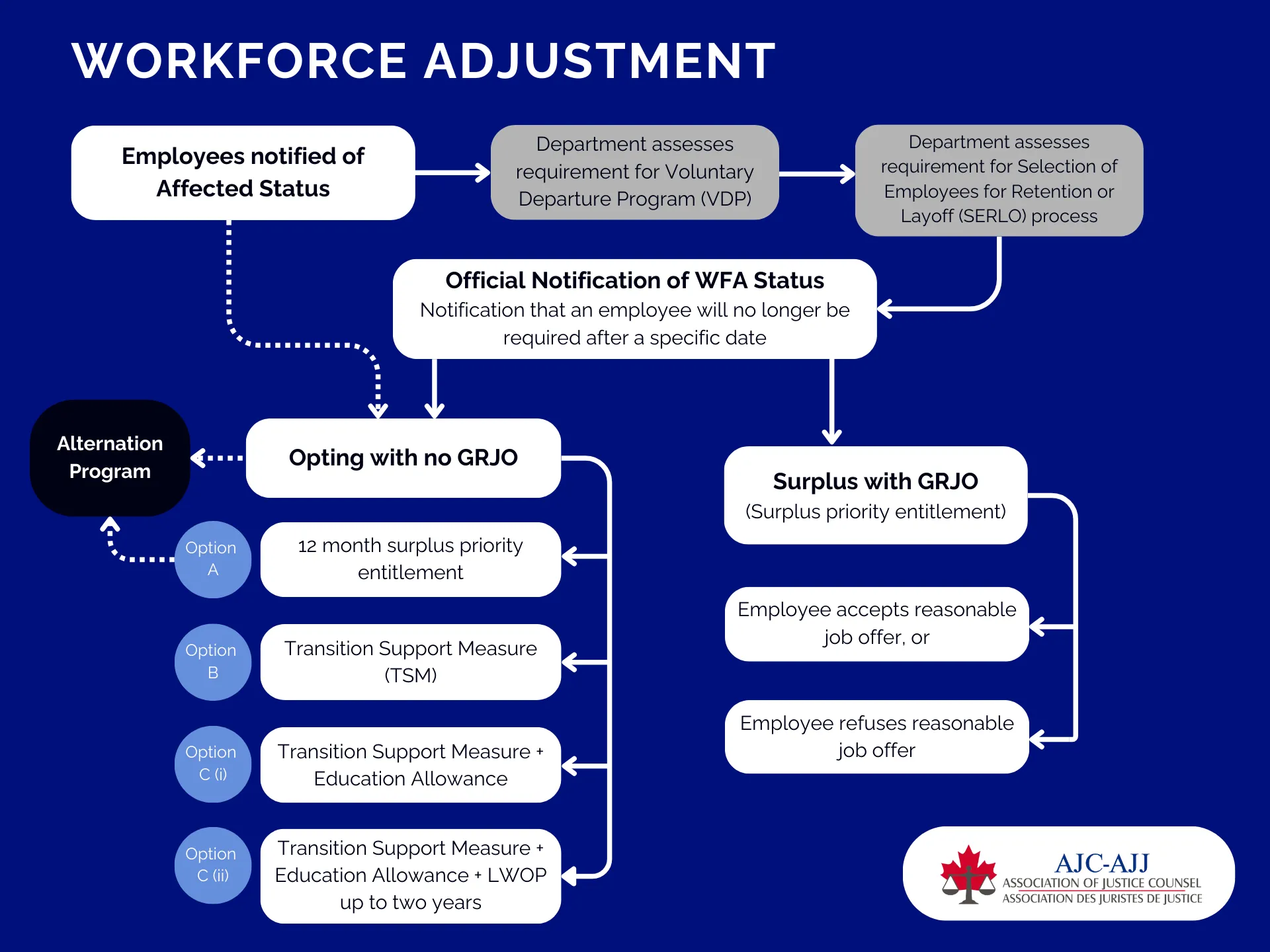
The letter will outline which of the possible scenarios applies to the employee:
1 - The position is eliminated and the employee will be deemed Surplus with the Guarantee of a Reasonable Job Offer (GRJO).
In this case, the department predicts indeterminate employment for which the employee is qualified will be available within the core public service. In this situation, the department will provide the Employee with a Guarantee of a Reasonable Job Offer (GRJO) and they will be placed on a Public Service Commission (PSC) priority list until they either receive and accept a reasonable job offer, resign, or refuse a reasonable job offer.
2 - The position is eliminated and the Employee is declared an Opting employee.
If the employee is not provided with a GRJO, the department will notify the employee that their position is eliminated, and they will be considered “opting”.